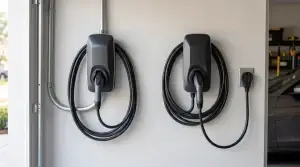

For Jacksonville homeowners planning a permanent Level 2 charging setup, a hardwired EV charger is often the better choice, especially for outdoor installations. A plug-in charger offers more flexibility if you plan to move or replace the equipment. At Pier Electric, we help homeowners evaluate these options based on their vehicle’s charging capabilities, their home’s electrical capacity, and where they plan to park.
A hardwired charger connects directly to a dedicated electrical circuit, while a plug-in model uses a compatible 240-volt receptacle, commonly a NEMA 14-50. Both support Level 2 charging, but their installation requirements and long-term flexibility differ.
Hardwired vs Plug-In EV Charger: What Is the Difference?
One difference is how each charger connects to the home’s electrical system.
A hardwired EV charger is permanently connected to a dedicated circuit. To hardwire an EV charger, an electrician runs wiring from the main panel to the charging unit and makes the necessary electrical connections. There is no separate wall outlet or removable plug between the electrical panel and the charger.
A plug-in EV charger connects to a compatible 240-volt receptacle, commonly a NEMA 14-50. Unlike a hardwired unit, the charger can be unplugged and moved when needed. However, the receptacle and dedicated circuit must be suitable for the charger’s electrical requirements.
Both methods can provide reliable EV charging when the equipment is selected correctly and installed according to electrical code. The important differences involve charging speed, flexibility, installation costs, and long-term use.
Charging Speed and Maximum Amperage
Charging speed for an electric vehicle depends on the charging station and the vehicle’s onboard charging limit. As the U.S. Environmental Protection Agency explains, a higher-output station does not always provide faster charging speeds.
|
Feature |
Hardwired Charger |
Plug-In Charger (NEMA 14-50) |
|
Charging current |
48 amps or higher, depending on equipment and circuit capacity |
Up to 40 amps |
|
Circuit requirement |
60-amp circuit for 48-amp charging; higher outputs require appropriately sized circuits |
50-amp dedicated circuit for 40-amp charging |
|
Charging potential |
Higher output can support faster charging |
Often sufficient for overnight charging |
|
Best suited for |
Drivers needing higher charging output |
Homeowners with moderate daily charging needs |
The EPA’s home EV charging guide explains these circuit requirements. For the fastest possible charging speeds, a higher-output hardwired unit may be preferable, but maximum performance still depends on the vehicle, battery capacity, starting charge level, and available electrical power.
Hardwired EV Charger Installation
Hardwired chargers are permanent fixtures in homes. For permanent installations, an electrician assesses panel capacity, runs appropriately sized conductors, mounts the charger, connects it, and tests the system. A lockable disconnect is added when required by applicable codes or equipment instructions.
The absence of a visible outlet can be a selling point, but moving the unit later generally requires an electrician. For Tesla installations, see our guide to Tesla charger permit requirements in Jacksonville.
Plug-In EV Charger Installation
With a compatible receptacle installed near the parking area, a plug-in charger can be unplugged and moved. Plug-in chargers allow easy upgrades to newer models. This flexibility is useful for renters, although installing a new outlet or circuit generally requires the property owner’s approval and any necessary permits.
If a new outlet is needed, have an electrician install a dedicated circuit and suitable NEMA 14-50 receptacle. An electric dryer outlet may use a different NEMA configuration and circuit rating.
NEMA 14-50 outlets can serve multiple high-power devices. That does not mean multiple devices should be connected at once or that every existing outlet is suitable for EV charging: its wiring, circuit protection, receptacle condition, and capacity for continuous charging must be verified first.
Installation Costs
Installation costs depend on whether the home already has a suitable dedicated circuit, the distance between the electrical panel and the parking area, and whether additional wiring, permits, or electrical upgrades are needed. The U.S. Department of Energy’s home charging guidance also recommends having a qualified electrician assess the home’s available capacity before installing Level 2 equipment.
A plug-in installation is not necessarily less expensive. Adding a new heavy-duty outlet, such as a NEMA 14-50 receptacle, and a dedicated circuit can involve much of the same electrical work as installing a hardwired charger. An existing outlet may reduce installation work, but its condition and compatibility must be evaluated first.
Commercial charging projects have different cost considerations, including the number of charging ports, site preparation, and utility requirements. If you’re also planning charging infrastructure for a business property, our guide to commercial EV charging station costs explains these additional factors.
Safety, GFCI Breakers, and Reliability
Both hardwired and plug-in EV chargers can operate safely when properly installed. Electrical codes address wiring, grounding, and protection against faults such as a short circuit, but the requirements differ by connection type and location.
Key safety considerations include:
- GFCI protection: Section 625.54 of the 2020 National Electrical Code requires GFCI protection for receptacles installed for EV charging, as explained by the International Association of Electrical Inspectors. Requirements for hardwired equipment depend on the applicable code and installation.
- Built-in protection: Many chargers include ground-fault protection, but this does not automatically replace required circuit protection. If nuisance tripping occurs, an electrician should check the equipment and protective devices.
- Hardwired connections: Hardwired systems reduce potential failure points compared to plug-in chargers. Eliminating the separate plug and receptacle removes a weak point where loose or worn contacts could overheat.
- Plug-in connections: A properly rated receptacle can provide reliable charging, but loose connections, discoloration, unusual warmth, or visible damage require professional inspection.
Jacksonville Weather and Outdoor Charging
Jacksonville’s frequent rain and high humidity make moisture protection important for outdoor EV charging. Properties near the Atlantic coast may also face salt-air exposure that contributes to corrosion.
Hardwired units eliminate the external plug-and-receptacle connection, but weather resistance depends on the charger’s outdoor rating and installation. Plug-in systems require appropriately rated receptacles, covers, and enclosures. A distant driveway or detached garage may also require additional wiring.
Which Installation Method Makes the Most Sense?
Some homeowners prefer a hardwired EV charger if they:
- Plan to stay in the home for several years
- Want the maximum charging speed
- Own an EV that can accept up to 48 amps
- Charge frequently or drive long distances
- Prefer a permanent fixture
- Want a cleaner professional appearance
- Are installing the charger outdoors
- Want to reduce potential outlet failure points
Others may prefer a plug-in EV charger if they:
- Rent their home
- Expect to move soon
- Want to take the charger with them
- Already have a compatible NEMA 14-50 outlet
- Want easier equipment replacement
- Do not need the fastest available charging speed
- Charge overnight and have moderate daily charging needs
There is no single installation method that suits every EV owner. Your vehicle’s charging capability, home’s electrical panel, parking location, budget, and future plans should all be considered together.
How Pier Electric Can Help
Pier Electric provides EV charger installation in Jacksonville, including hardwired chargers and NEMA 14-50R outlets. Licensed electricians can evaluate the electrical panel, review the property’s power demands, and recommend a charging station setup that matches the vehicle and the home.
If the existing electrical panel cannot safely support the new load, an electrical panel upgrade or another electrical solution may be needed. Professional installation also helps ensure that the charging system is installed correctly and complies with applicable electrical requirements. To future-proof their electrical setup for battery storage or other major upgrades, homeowners can explore our home electrification services.
JEA closed enrollment in its EV Electrical Upgrade Rebate and Off-Peak Charging Incentive programs in November 2025. Jacksonville homeowners should check JEA’s current EV incentive information before factoring potential rebates into their installation budget.
Contact Pier Electric to discuss your EV charging requirements and determine whether a hardwired installation or plug-in setup is the right fit for your home.
Frequently Asked Questions
Do hardwired EV chargers need a GFCI breaker?
Not always. Hardwired chargers do not use a receptacle, but certain outdoor installations may still require GFCI protection under applicable codes. An electrician should confirm the requirements for the equipment and location.
Can I use an existing NEMA 14-50 outlet for EV charging?
Possibly, if the outlet and dedicated circuit are compatible with the charger. An electrician should check the receptacle, wiring, grounding, and circuit protection before regular use.